fb

Wednesday, 6 September 2017

WhatsApp announces free Business 
WhatsApp is gearing up to finally monetize its messaging app by charging large enterprise businesses for tools to better communicate with customers. WhatsApp will also offer a free app to small-to-medium sized businesses, though it hasn’t outlined the specific functionality of the app. The enterprise solution will allow global companies “to provide customers with useful notifications like flight times, delivery confirmations, and other updates”.
“We do intend on charging businesses in the future,” WhatsApp’s Chief Operating Officer Matt Idema told the Wall Street Journal. “We don’t have the details of monetization figured out.”
The company did write that it wants to facilitate “someone placing an order with a local bakery or looking at new styles from a clothing store” and “shopkeepers who use WhatsApp to stay in touch with hundreds of customers from a single smartphone”, plus offer “an easier way to respond to messages.”
Perhaps WhatsApp could charge enterprises like “airlines, e-commerce sites, and banks” to have multiple representatives managing an account or sending high volumes of messages. It could also charge for artificial intelligence bot functionality or ecommerce transactions.
WhatsApp also officially announced its closed pilot program for verifying business accounts with a green checkmark to distinguish them from personal accounts and fakes.
WhatsApp began testing verified accounts for businesses a week ago. Conversations with businesses are encrypted and they can be blocked. Interestingly, if a business isn’t already in your phone number contacts, its name will appear as whatever they register themselves as instead of their number. This could allow WhatsApp to create a business search engine with optional sponsored results, or let businesses cold-message people, possibly for a fee.
Alternatively, businesses on WhatsApp may need to be contacted by a user first before they can respond with organic or sponsored messages. That’s how Facebook Messenger works, and it’s led to businesses buying “tap-to-message” ads on Facebook’s News Feed to get people to initiate conversations so the business can follow up with sponsored messages. Not allowing cold-message ads meshes with WhatsApp writing that it plans to “make it easier for people to communicate with the businesses they want to reach on WhatsApp”, emphasis mine.
[Update: WhatsApp now confirms our hunch, telling TechCrunch “Businesses will only be able to contact people who have provided their phone number and agreed to be contacted by the business over WhatsApp.”
The company also says that the enterprise solution will initially be free but it does plan to charge businesses. Some functionality that will be offered by the Business app and enterprise solution includes the ability to create a verified profile with info like address, description, and hours, plus “Features for helping manage customer chats like away messages for when businesses are not able to respond at the moment.”]

Remember when WhatsApp didn’t want to make money?


It’s a great move.
Messaging is huge, and there is vast scope for bringing brands and businesses on board. It’s a process that’s been happening for years, predominantly with Asia-based chat apps that let users follow official accounts, but enterprising business people in emerging markets have long found ways to make use of the hugely popular WhatsApp service despite no features.
Two years ago I wrote that chat apps were becoming as important as social media for brands, and that shift has only continued. So it is high time WhatsApp got on board given its insane userbase of more than one billion people.
But it wasn’t always that way.
WhatsApp once had a very strict focus on messaging only, with plenty of negative words for rival companies who dared to mix business with their chat app product

Tuesday, 5 September 2017

Aston Martin’s vehicle lineup will be 100% hybrid by the mid 2020s

Another automaker is vowing to turn its entire lineup a little more green: Aston Martin told theFinancial Times that it’ll offer vehicles exclusively with hybrid and electric cars by the middle of next decade.
It’s not as audacious a goal as it might’ve seemed even just a few years ago; Volvo has committed to selling only hybrid or electric cars by 2019, and Britain and France have both outlined plans to ban the sale of non-electric or hybrid vehicles by 2040.
Aston Martin’s announcement is significant because it’s a high-end luxury performance car maker, however, whose target demographic is precisely motoring enthusiasts. Aston Martin had previously announced plans to launch its first fully electric car, the Rapid-e, by 2019.
Don’t expect news of automakers intending to focus solely on hybrids and electrics to stop anytime soon; the writing is on the wall, now it’s just a question of in what order the dominoes fall.

Logitech’s latest keyboard, The Craft, adds a smart knob called The Crown

Smart knobs have a short and not very illustrious history, but that doesn’t mean they aren’t cool. That, at least, appears to be the thinking at Logitech, which has just added a smart knob (or dial if you’d rather) to its newest wireless keyboard. The Crown, they call it — and the keyboard it sits on is The Craft. Well, they don’t capitalize it that way, but I do.

Now, to be honest, comparisons to Microsoft’s Surface Dial aren’t really warranted. That one is context-sensitive based on where you place it as well as what app you’re in. It’s meant to turn the Surface Studio into a sort of cyborg creation engine as you wield the pen in one hand and dial in the other.Basically the Crown lets you control a variety of settings or interface elements depending on the app: Zoom in Photoshop, exposure compensation in Lightroom, column in Excel, and so on. We’ve seen things like this here and there, and Logitech’s is a respectable specimen: understated in design and compatible with major apps out of the box.
The Crown is more like someone wrote a script that mapped the volume dial on a keyboard to identify as a human interface device input when you open certain apps. Not exactly groundbreaking, but if you’re buying a wireless keyboard, why not get one with a sweet knob?
The Craft and the Crown, which sounds like a bar that’s too expensive for me to drink at, will cost $199 when it hits stores in October.

Tinder Gold, which lets you see who has liked you, launches today in USA

As Rafiki once said, “It is time.”
Tinder Gold, the dating app’s new premium subscription tier (which includes a feature that lets you see who’s already liked you without any swiping) is finally rolling out to the U.S.
Tinder Gold and Likes You were originally tested in Argentina, Australia, Canada and Mexico at the end of June. Today, however, the the feature rolls out to all Tinder users across the globe.
One of Tinder’s greatest obstacles has always been balancing the game of Tinder with the utility of Tinder. Those who were actually looking for a romantic endeavor were often inundated with matches that were simply swiping for the sake of swiping. In fact, before Likes You, the only way Tinder users had access to everyone that liked them was to swipe right on everyone.
Tinder’s Right Swipe Limiter worked well to curb that, but Likes You is a great way to make some cash on the back’s of users’ insatiable curiosity.
The company says that more than 1.6 billion swipes go down on Tinder each day around the world.
“Some users have a lot of time to spend swiping and connecting with new people, but we’ve found that others want to maximize the time they’re able to spend on the app, and Likes You gives those users a way to swipe, match, and start chatting seamlessly,” said Tinder Chief Product Officer Brian Norgard. “Tinder Gold provides subscribers with the fun and engaging swiping experience they love about Tinder, coupled with the efficiency and control of being able to see who’s swiped right on them first.”
Tinder Gold includes many of the Tinder Plus features, such as Passport, Rewind, Unlimited Likes, five Super Likes per day, one Boost per month, and other profile controls. And you can’t forget Likes You.
Tinder Gold pricing is still being tested, but the current price is $4.99/month. The company toldBuzzfeed that, during testing in other countries, your average Tinder Gold user received around 60 percent more matches compared to free Tinder users

Google reveals the top things people want to find out ‘How to’ do.

Google has a new website compiled using search data and built by its News Lab, working together with Xaquin G.V., an interactive visual data journalist. The site uses data related to searches made by users about “How To” do things, which represents a massive amount of activity on Google, it turns out.
Xaquin explains in the visual essay that he was inspired by his own searches, stemming from a general lack of handiness around the house. I sympathize – I spend a lot of time on Google trying to figure out how to do relatively basic things like fix a toilet pump or wire a doorbell.
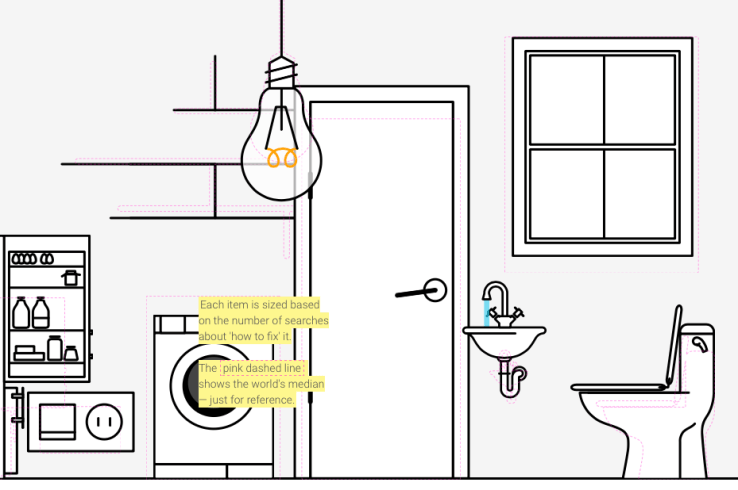
The new site designed by Xaquin working with Google and its Trends tools allows users to enter whatever country they want into a field to see what the top “how to” searches are for their region. The relative popularity of things around the house people search to fix are represented by larger or smaller graphics in a household scene – in Canada, for instance, it turns out doors are really commonly searched for, as well as fridges and toilets.
The essay also examines the top 100 ‘How To’ searches made worldwide to see what people generally needed assistance with, and those results are very illuminating. Xaquin broke them down into categories, with visual representations of how popular each is.
People want to know how to make pancakes, make money, lose weight and boil eggs. People really, really want to know how to kiss, get pregnant, and tie a tie. And if you’re actually curious about how to do those things, too, you can click through on any result graphic to be taken to the actual Google results.
The site is responsively designed and looks great on mobile. Google News Lab Data Editor Simon Rogers told me that a focus on mobile performance is a priority for its experiments in visual storytelling, given how much of the audience accesses via mobile devices.
Rogers also said that projects like this help Google explore what its data might be able to do in terms of telling stories and fueling interesting developments in data journalism.

How the Essential Phone won me over completely.


How the Essential Phone won me over completely
Still, Essential saw something missing in the now very mature smartphone market, and led by Android creator Andy Rubin, set out to address that gap.
The Essential Phone (PH-1 by technical model name) is the fruit of that labor, created by what seems like an impossibly small team, that number under 100 and for much of the device’s development, actually numbered far fewer. It’s an Android smartphone, and it’s most remarkable feature is probably it’s nearly full-face display, which leaves only a thin rectangle of black bezel at the bottom, along with a cutout for the front-facing camera at the top.
But after having used the Essential Phone for a few weeks, the standout feature isn’t the display (or the modular magnetic attachment on the back of the device, which supports the Essential 360 camera and other future accessories). Instead, it’s something far less tangible: The ability of the phone to elicit an emotional reaction – something that very few smartphones today can achieve, and certainly not to the same extent.
The stated goal of Essential is to create a “lovemark” for Android smartphones, something that hasn’t really happened yet in the North American market. That’s according to Essential President Niccolo de Masi, who told me that Essential hopes to achieve the kind of relationship with its customers that Apple has managed to secure with its iPhone fans.
Based on my experience, this is exactly what Essential has managed to do. Using their first smartphone felt a lot like using my first iPhone, which was the iPhone 3G (the first model commercially available in Canada). And I don’t mean that to say that the experience felt unfinished or rough around the edges, but rather that the Essential Phone invokes a certain kind of joy.
It’s rare for any kind of smartphone to evoke an emotional response from me these days; the technology is generally too commonplace, and iterative, with not much in the way of large technological leaps or feature additions with each successive generation and device model. Generally speaking, with current phones, I can appreciate their technical achievements, but none have come close to matching that iPhone 3G in terms of a sense of personal attachment

WhatsApp announces free Business app, will charge big enterprises.

WhatsApp is gearing up to finally monetize its messaging app by charging large enterprise businesses for tools to better communicate with customers. WhatsApp will also offer a free app to small-to-medium sized businesses, though it hasn’t outlined the specific functionality of the app. The enterprise solution will allow global companies “to provide customers with useful notifications like flight times, delivery confirmations, and other updates”.
“We do intend on charging businesses in the future,” WhatsApp’s Chief Operating Officer Matt Idema told the Wall Street Journal. “We don’t have the details of monetization figured out.”
The company did write that it wants to facilitate “someone placing an order with a local bakery or looking at new styles from a clothing store” and “shopkeepers who use WhatsApp to stay in touch with hundreds of customers from a single smartphone”, plus offer “an easier way to respond to messages.”
Perhaps WhatsApp could charge enterprises like “airlines, e-commerce sites, and banks” to have multiple representatives managing an account or sending high volumes of messages. It could also charge for artificial intelligence bot functionality or ecommerce transactions.
WhatsApp also officially announced its closed pilot program for verifying business accounts with a green checkmark to distinguish them from personal accounts and fakes.
WhatsApp began testing verified accounts for businesses a week ago. Conversations with businesses are encrypted and they can be blocked. Interestingly, if a business isn’t already in your phone number contacts, its name will appear as whatever they register themselves as instead of their number. This could allow WhatsApp to create a business search engine with optional sponsored results, or let businesses cold-message people, possibly for a fee.
Alternatively, businesses on WhatsApp may need to be contacted by a user first before they can respond with organic or sponsored messages. That’s how Facebook Messenger works, and it’s led to businesses buying “tap-to-message” ads on Facebook’s News Feed to get people to initiate conversations so the business can follow up with sponsored messages. Not allowing cold-message ads meshes with WhatsApp writing that it plans to “make it easier for people to communicate with the businesses they want to reach on WhatsApp”, emphasis mine.
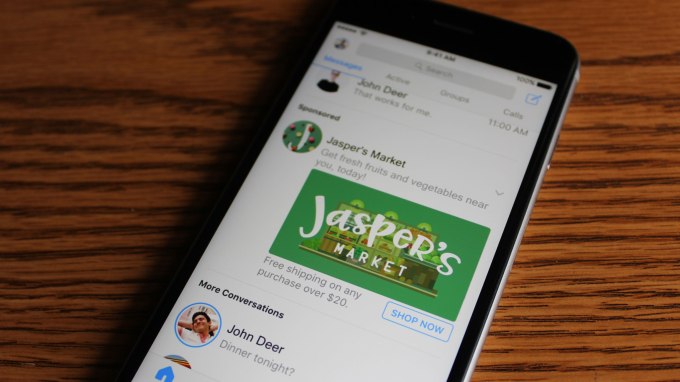
Facebook Messenger inserts display ads into the inbox
When Facebook acquired WhatsApp for $19 billion in 2014, the companies said they wouldn’t put ads in WhatsApp because it would degrade the experience. But it also ditched its $1 annual subscription fee, leaving few monetization options beyond charging businesses for tools. The introduction of display ads and sponsored messages to Facebook Messenger may indicate a relaxation of WhatsApp’s stance against ads.
With over 1.3 billion monthly users and 1 billion daily users, WhatsApp has reached the massive scale necessary for it to earn significant revenue even from light advertising. Its Snapchat Stories clone WhatsApp Status now has 250 million daily users, and could host vertical video ads between friends’ content the way Instagram does. It could also insert display ads into the inbox like Facebook Messenger.
After being one of tech’s biggest startup acquisitions, WhatsApp has tripled in size under relatively hands-off management by Facebook. Now it’s time to earn its keep.

SpaceX runs its Tesla-powered pusher at 220 mph on Hyperloop test track.

Elon Musk apparently felt left out when student teams competed to achieve top speed on the SpaceX Hyperloop test track last weekend, because he decided to run the SpaceX pusher vehicle, which includes a Tesla drivetrain, down the track on its own to see how fast it could go.
The Tesla/SpaceX vehicle, which works basically like a Hyperloop tug boat to propel some of the student pods that don’t have their own built-in motor for acceleration, managed to get up to 220 mph in the sealed vacuum tunnel, which is faster than the winning student team at 201 mph.

Samsung’s Galaxy Note 8 is a cautious return for the world’s best phablet.


Samsung’s Galaxy Note 8 is a cautious return for the world’s best phablet.

Samsung’s Galaxy Note 8 is a cautious return for the world’s best phablet
Between the explosions, the recalls and its subsequent afterlife as airport PA system fodder, it’s easy to lose sight of the fact that the Galaxy Note 7 was a very good phone. In fact, the line has always been one of the industry’s best and most innovative. It seems it only takes a few well-publicized explosions to tarnish a beloved brand.
But Samsung rebounded quickly. In fact, the company didn’t appear to take any real financial hit from the Note 7 fiasco. It did, however, do its due diligence, investigating the cause of the phone’s battery issues, publicly apologizing and instituting an eight-point safety check in hopes of assuring that it wouldn’t ever repeat its mistakes again. And in spite of some momentary speculation that the company might dump the Note altogether, it was pretty clear to Samsung from the outset that the name it had spent a half-dozen years building up was too valuable to abandon.
Unveiled late last month, the Note 8 is the product of a newly cautious company. It’s easy to see how Samsung’s relentless push to include all the latest bells and whistles might have contributed to its predecessor’s problems. The new Note isn’t a bombardment of new features. Much of what the product brings to the table was borrowed directly from the recently announced Galaxy S8. And most of the rest that’s new seems to largely be an attempt to distinguish the phablet as a more premium option than the similarly sized Galaxy S8+
But that’s not a bad thing, really. The new device is built atop one of the most solid foundations in the smartphone space. And the additions — refinements, really — mostly help to make it that much better.